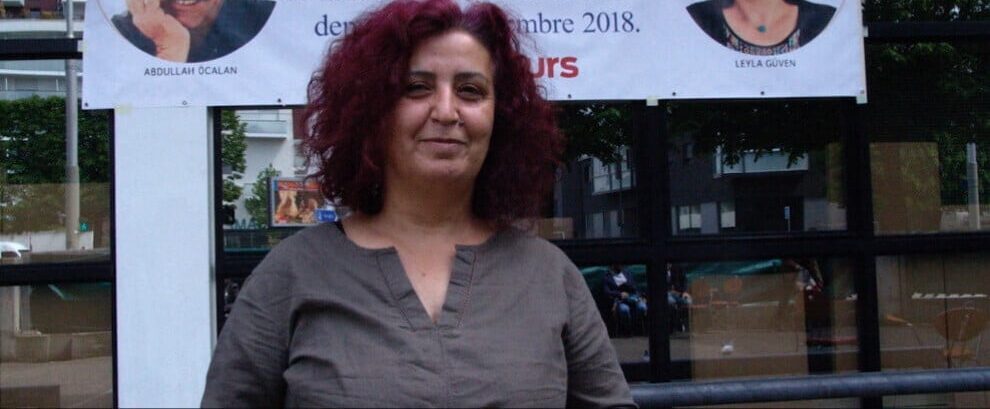
Fatoş Göksungur said that democracy depends on both ecological balance and women’s freedom, stressing that one cannot exist without the other.
The geography of Kurdistan is among the regions where policies of ecocide are implemented most intensely. Water is used both as a tool of demographic transformation and as a security instrument; militarily restricted zones are opened to mining projects; highlands that have been used for animal husbandry for thousands of years are turned into solar power plant sites; ancient cities such as Hasankeyf and Zeugma are submerged under dam waters, among many other practices.
Announcing its establishment at a workshop held in 2024 in the German city of Freiburg with the participation of dozens of ecology activists, the Europe–Kurdistan Ecology Movement (TEV-EKO) aims to expose policies and practices of ecocide in Kurdistan to the public through the perspective of an ecological society, to build organization at the local level, and to develop international cooperation in the field of ecology.
TEV-EKO Co-Spokesperson Fatoş Göksungur spoke to ANF about the movement’s founding objectives, its goals, the visibility of ecocide policies in Kurdistan, and its priorities for the period ahead.
Could you summarize TEV-EKO’s founding objectives and its main areas of work so far? What distinguishes TEV-EKO’s approach to the ecological struggle?
To understand TEV-EKO, it is first necessary to ask why it emerged. Our main point of departure was the paradigm reshaped by Abdullah Öcalan through the system of democratic confederalism. Within this framework, democratic modernity is constructed as a way of life resting on three fundamental pillars: an ecological society, a democratic society, and a women’s freedom, based society. One of these three pillars is the ecological dimension.
When viewed holistically, it becomes clear that none of these can exist without the others. A democratic society is only possible if there is an ecological society; likewise, a truly democratic society cannot exist without a women’s freedom, based social structure. It is evident that one cannot be sustained without the other.
From around 2005 onward, as organizing efforts developed on the basis of this new paradigm, the weakness of organization in the ecological field became increasingly visible. Despite the fact that the dirty war waged by the state against Kurdish society in Kurdistan has included ecocide as one of its dimensions, the focus largely remained on questions of status and politics. As a result, policies of ecocide did not receive the attention they deserved.
In Europe, there was an additional distance created by being physically removed from Kurdistan. Here, too, the issue of status was approached mainly through an administrative and political lens or, to put it differently, through a discourse of political status detached from the ecosystem itself. Because of these inadequate approaches within our organizational framework, the need for organizing in the field of ecology began to impose itself more forcefully.
In 2023, at the Congress of the Kurdistan Democratic Communities in Europe (KCDK-E), a decision was taken to establish a committee focused on ecology, and we assumed responsibility for this work. In a sense, this was also a form of self-criticism for not having sufficiently foregrounded ecology during the period in which we served as co-chairs. From July 2023 onward, we began ecological organizing in Europe at the committee level. The committee initially started with five people and gradually expanded through discussions with others. From the outset, we emphasized that what distinguishes us from other ecological movements is the need to organize specifically within the field of social ecology. In line with this perspective, we began forming committees in various countries up until December 2024.
Finally, at a workshop we organized in December 2024, with the participation of activists from all organized fields within KCDK-E in Europe, we officially announced the establishment of TEV-EKO.
What are the most visible examples of the long-standing ecological destruction in Kurdistan? How does this devastation affect the daily life and cultural continuity of the Kurdish people?
Abdullah Öcalan has defined ecological struggle as something that “must be the most radical form of struggle.” This assessment is crucial when viewed against the backdrop of the state’s war policies. Over the past fifty years in Kurdistan, thousands of villages have been forcibly evacuated and millions of Kurds have been displaced. This has meant not only forced migration, but also the severing of the Kurdish people’s bond with their land. The burning of forests signifies both the destruction of Kurdistan’s nature, and the eradication of its endemic plant diversity.
Beyond this, there are also policies of ecocide carried out under military and security justifications. The mountains of Kurdistan are bombed, and Kurdish villagers are displaced, forced to migrate both to metropolitan centers in Turkey and to Europe. In other words, under the pretext of war, a comprehensive ecocide policy is being implemented that targets Kurdistan’s air, water, soil, nature, forests, and all living beings inhabiting these lands.
At the same time, areas closed to civilians under the labels of “special security zones” or “military restricted zones” are being transformed by the state into mining sites, hydroelectric power plant projects, and dam construction areas. While policies aimed at altering the demographic structure of Kurdistan are pursued on one hand, an integrated ecocide strategy is implemented on the other through dams and mining operations.
One of the most striking examples of this today can be seen in the mining sites in Şırnak (Şirnex). The near-total plundering of the natural environment in Dersim, and perhaps even more visibly and before the eyes of the world, the uprooting and transfer of thousands-year-old olive trees in Afrin (Efrin), stand as stark examples. Quite literally, the olive trees of Afrin have been stolen. The olive tree is significant both as a source of livelihood and as a symbol of harmony with nature.
In addition, dam policies imposed across Kurdistan are highly conspicuous. One of the most fundamental strategies pursued today is the use of water as both a security tool and a weapon. The Tigris (Dicle) and Euphrates (Fırat) rivers are two major waterways with the capacity to sustain Mesopotamia and perhaps much of the Middle East. Yet due to regional war policies, water is used as a weapon against Rojava, while in Northern Kurdistan (Bakur), dams are used to redirect water flows, submerging numerous historic cities.
The flooding of Hasankeyf, Samsat, Zeugma, Urfa (Riha), Halfeti, and surrounding villages represents some of the clearest examples of the ecocide policies and practices imposed on Kurdistan.
When issues such as forest fires, dam projects, and the mining activities you mentioned come to the fore, how does TEV-EKO build solidarity mechanisms and monitor these processes?
When we established and announced TEV-EKO in Europe, we defined our work around four main principles.
First, we aimed to promote social ecology consciousness as a way of life and understanding within assemblies and administrative structures in all areas where we are organized, and among all people from Kurdistan living in Europe.
Second, we set out to bring policies of ecocide in Kurdistan onto the agenda in Europe as well, and to carry out struggle around this issue.
Third, we are facing a global ecological crisis today. The planet we live on is being subjected entirely to the exploitation and plunder of capitalist modernity, to the point where even people’s daily lives are being poisoned. In this sense, building common ground and cooperation with ecological movements operating at the global level is one of our priority objectives.
The fourth principle and the most comprehensive and decisive one, is our effort to share Abdullah Öcalan’s paradigm of an ecological society with ecological movements worldwide, while also transforming this paradigm into a field of struggle and consciousness within our own organizational structure.
On this basis, an organizational framework was formed and continues to develop. Over our two years of organizing, have we been able to create sufficient sensitivity toward ecocide policies in Kurdistan? We are still far from where we need to be. But we are an ecology movement that acts with this awareness and bases its organizing efforts on building consciousness around it.
We emphasize this awareness particularly in the public meetings we hold and wherever we go, especially when responding to the question of why we organized TEV-EKO in the first place. One of the fundamental reasons is to bring ecocide policies, not only in Northern Kurdistan, but across all four parts of Kurdistan and the ecological destruction caused by capitalist modernity to the agenda, to explain them to our own society, and to work toward building this collective awareness.
TEV-EKO also carries out a number of digital campaigns. In your view, what kinds of strategies are needed to make ecocide in Kurdistan visible at the international level?
The ecological struggle will increasingly be carried out through campaigns in the period ahead. At present, one of the most urgent issues in Kurdistan is the embargo imposed on Rojava, and this has still not been lifted. Rojava is known as a major grain-producing region, a place where seeds are sown extensively, the land is cultivated intensively, and wheat production is at its highest levels. It is also one of the most important centers in terms of soil fertility across Kurdistan. Yet today, water is being used as a weapon against Rojava, and a food embargo is simultaneously being imposed.
At the same time, with the Peace and Democratic Society process now underway, our hope for the coming year is that ecological problems will be addressed through a social ecology perspective. This means dismantling an approach that treats water, food, seeds, trees, olives, and the nature of Kurdistan as hostages and instruments of war, and instead building an ecological way of life on a more democratic foundation, one shaped by society itself and rooted in its own needs.