All over the world, from Venezuela to Kurdistan, in Palestine, Sudan, and Somalia, war is being waged, and people are being forced to leave their homes. The forces that wage war share one central narrative: home. Whether in Syria or in Europe, the debate centers on who is allowed to call the land they live on home. In the last weeks of war in North-East Syria, thousands of people have lost their homes, their communities, their land. Most of them have experienced this before, and are right now being displaced for the third or fourth time. This article is not about war, but tries to grasp at some aspects about peace. What does true peace mean in these warlike times, and what does it have to do with home?
This story begins in Afrin.
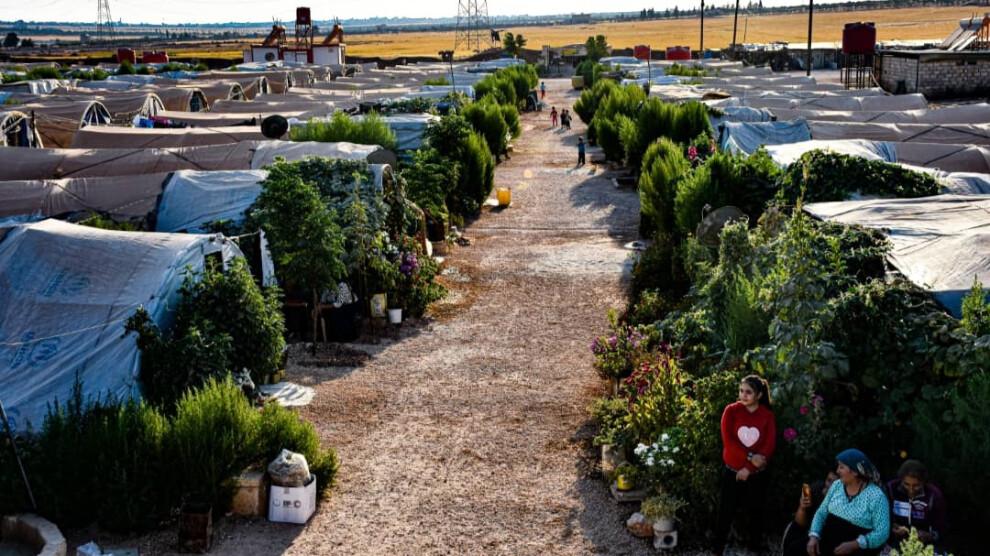
Afrin is a painful word for those who call it home, because they haven’t been there for a long time. Since the Turkish occupation in 2018, many have been living in a camp set up near to Afrin, in Shehba, staying as close as they could. Last winter, they were again forced out by the war waged by jihadist mercenaries, who have now been incorporated into the Syrian army. Many of the people stayed in a new camp in Tabqa. We visited them there, were invited into their tents, and heard about the hardships they face: the cold in winter, the heat in summer, but also their determination to stay together and one day return to Afrin. This winter, with Tabqa being attacked and taken by the Syrian transitional government and their jihadist mercenary gangs, these people were violently forced to leave once again. In the far northwest of Syria, the Afrin region was liberated from the Ba’ath regime in 2012 during the Rojava Revolution. As throughout the liberated territory, the people themselves established democratic institutions of self-governance. Since then, society had organized itself into communes and councils, a community economy was established through cooperatives, and a sense of community was developed through education.
“This means that whenever a decision was made, the commune was involved, and for problem solving as well. The commune creates the organization of society; we give it the greatest importance of all institutions and councils. Everyone finds a place in the commune,” says the women that are active in the institutions of self-governed refugee camp in Tabqa. This democratic system, in which every individual participates in decision-making processes, so that these are made in the interest of the common good, represents the people’s of North and East Syria vision of a free life. This life is based on democratic and ecological values, with the necessity of women’s liberation and gender equality taking center stage.
The women continue their story of life in Afrin: “At the beginning of the Rojava Revolution in 2012/2013, Afrin lived in a self-sufficient circular economy. People fed themselves from the land that surrounded them. Every house had trees in the yard and gardens. When growing plants for sale, chemical fertilizers are used to increase profits, but there was no such thing in Afrin. When the women grew food at home, they met the needs of their households and perhaps also those of their neighbors and friends. Afrin was isolated (besieged), and we could have survived like that for another ten years. Why? Because every house had its own garden that could provide for itself. The women were instrumental in this, cultivating and watering the land. They planted flowers here and tomatoes there. A delicate rose here and beans next to it. The people of Afrin grew everything themselves. In addition, every house had sheep for yogurt, milk, and cheese. And these, too, were mostly cared for by the mothers.”
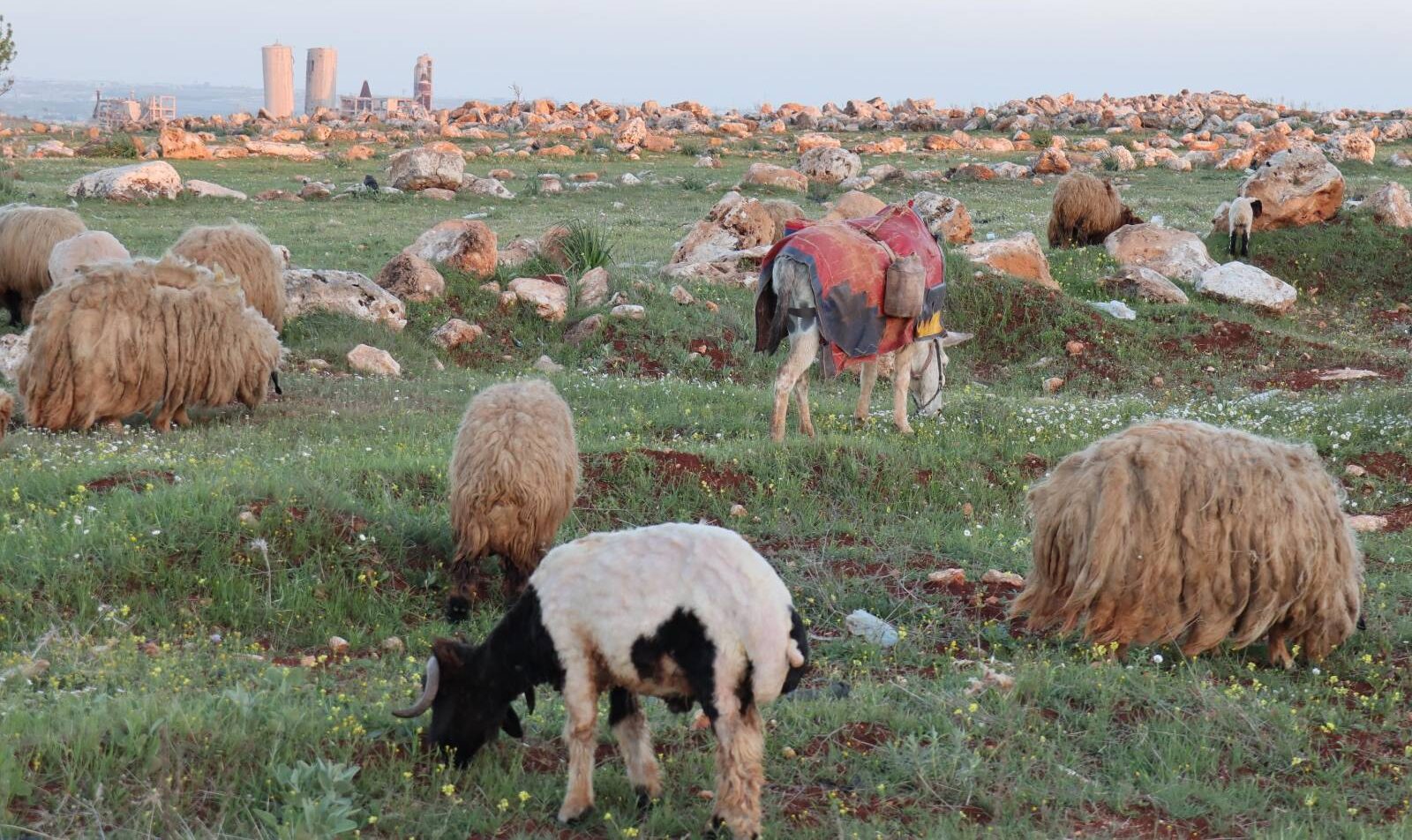
The women speak with pride about the natural circular economy and the importance of self-sufficiency in times of war and siege. The role of women and mothers in this, as the bearers of this communal life, is paramount for them. They speak of how green their homeland of Afrin is, in contrast to the arid landscape where they are now trying to rebuild their lives.
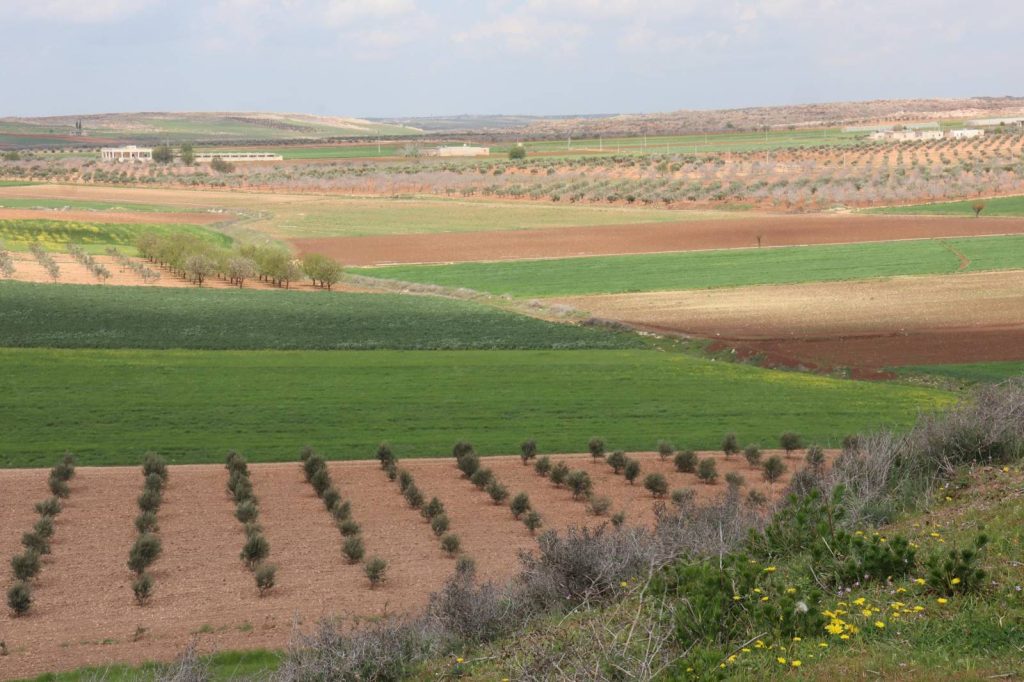
“You’d think you couldn’t plant anything [here], but we’ve planted everything”.
They don’t mean just any green, not lush grass green or dark fir green, but the gray-green of olive trees. Afrin is famous for its olive trees and oil production. The Turkish army, which violently disrupted communal life in Afrin in January 2018, called its military offensive “Operation Olive Branch.” With the newly created mercenary group “Syrian National Army” (SNA), which is intended to implement Turkish interests on the other side of the border in Syria, an offensive war against Afrin began on January 20th.
“During the Afrin War, there were suddenly warplanes in the sky above us. We had never seen anything like it in our lives. We had no experience of war,” the women recount about that day. Turkish interests were focused on defending a concept of homeland that allowed only one ethnic group, one language, one culture, and one religion to be at home. To establish this understanding, the Turkish state was built on the foundation of denying Kurdish society, language, ethnicity, and culture. The vibrant community life that developed through the Rojava Revolution on the other side of the Turkish border threatened to disprove this concept, especially since it was led by a Kurdish initiative. The women from Afrin tell how, through the shared resistance of women, ethnic divisions were overcome, as they assumed a leading role for the entire society.
The truth is, women have led life for thousands of years. But we, in the midst of it all, faced many difficulties. Whether we like it or not, in culture, religion, everywhere there are customs and traditions. The efforts and work of the women’s movement became a model and a source of strength for us. Within society, as women, to build autonomy among women, to get to know ourselves and liberate ourselves… and with this become pioneers for all women worldwide… In Afrin lived mainly Kurdish and Arab women, a few Turkmen families as well. When we talked about building up women’s communes, it felt as if the whole society was moving toward a line of correction. Society could take a deep breath… could breathe more easily. We made educations about the defense of women’s rights. Freedom is not easy… Women’s liberation means women must get to know themselves. We needed women’s communes because in them women could share their pain and suffering caused by oppressive traditions, fathers, brothers, or husbands with each other.
Two months after the start of the war of aggression, on March 18, 2018, the Turkish-backed SNA began its occupation of Afrin. They looted villages, raped, murdered, kidnapped, tortured, and committed numerous massacres of civilians. Speaking the Kurdish language became banned and persecuted, and the historically significant olive groves were burned. Thousands of people were forced to leave their home. Since Afrin had become a refuge for many fleeing previous wars, such as the ISIS attacks in Shengal, this displacement was the second in the lives of many. The people of Afrin did not give up their goal of returning home and therefore only traveled as far as necessary. Many went to Aleppo or Shehba. Shehba was also surrounded by the Turkish occupation and the totalitarian Syrian Assad regime and subjected to an economic embargo and constant attacks. The thousands of internally displaced people from Afrin did not give up and developed a vision of a free, communal life in the refugee camps.
After our arrival [in Shehba], we spent three months visiting families in tents. We went from house to house and talked about how women could support themselves, identify problems early on, and keep their children and the surrounding area clean. Because when women are well-prepared and empowered, they can provide for the whole family. Afterwards, we met in the community council. We discussed our situation, the war situation, how we had been displaced, and how we wanted to organize ourselves in the future.
In the refugee camps, self-defense was also organized. “If a stranger arrived (to the camp), someone from the self-defense committee would immediately check who it was. Now, three-quarters of the members of the self-defense committee are women. In general, the women are the ones who do the most work. Despite all the difficulties in the tents, especially for families with children, the women are resisting, organizing themselves, and defending themselves and their families.” Self-defense encompasses many roles. Some stand guard, go on patrol, and learn how to use weapons. Others “said they were needed at home, but they would inform the others if they noticed any problems.” Their aim was not only to organize daily life well in the war situation, but above all to create a future that could overcome the war.
We had set up a nursery in Shehba. Everything was ready for the children’s first day. The teachers had painted pictures on the wall. They asked, ‘Should we paint a car?’ I said, ‘Everything we paint should be from nature.’ They asked, ‘Why?’ and I said, ‘So that the children, both girls and boys, can observe nature and find peace. So that they grow up with love. When they observe nature, love will develop within them. Then they will also love their surroundings in general.’ The teachers agreed. Whoever loves nature loves everything. But we had to give up the daycare center and leave Shehba.
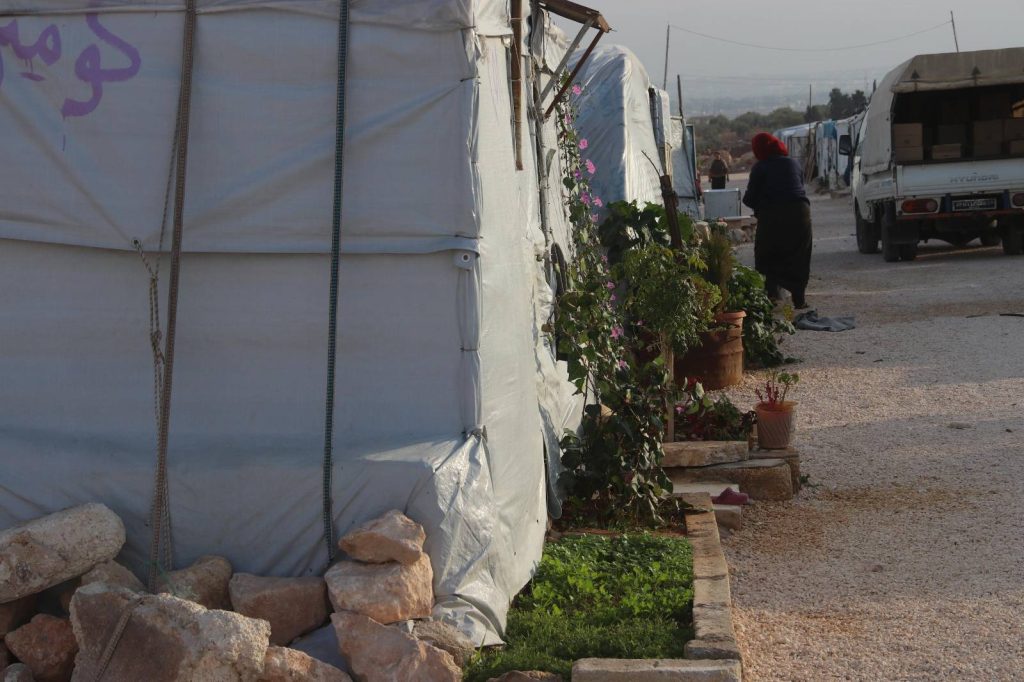
For seven years, the people from Afrin had lived in Shehba, continuing their self-governance in the camps and defending these values against the Turkish attacks. “When your hands plant something in the earth, you build knowledge and energy. When you are separated from that… Have you seen what they are doing to the olive trees in Afrin? They are cutting down the olive trees. Have you seen it? You cannot separate the women of Afrin from nature. People think that nothing grows in the camps. But we have planted everything. To be separated from that is like being separated from your own beauty, the love of life, of your spirit.”
When the Assad regime was overthrown in the fall of 2024, Turkey seized the opportunity and attacked the region with air and ground strikes by the SNA and the Turkish military. On December 2, 2024, the refugee camps were evacuated, and the people were forced to flee once again.
“This has an impact on people. Women are affected the most. Because they are often tied to the home, taking care of the household, raising the children. Whether everything necessary for life is available or not, whether there is work or not, whether everything is running smoothly or not… it affects them greatly. Some problems and difficulties are experienced as a result of this escape,” one of the women explains.
Another woman adds:
When we had to flee Shehba and came here, think about it, it was the middle of winter. We were in tents in the cold. But the women resisted and defended themselves in the camps, because a woman who isn’t organized and can’t defend herself, can’t live under such conditions. […] Together, the women support each other and encourage one another to defy the conditions.
Some families went to the cities and found work, others moved to other refugee camps, like the women interviewed in Tabqa, and still others moved to Aleppo. In Aleppo, they were integrated into the neighborhood communities in the self-governed districts of Sheikh Maqsoud and Ashrafieh and became involved in the committees. The remaining parts of Aleppo were under the control of the new Syrian Transitional Government, which was formed after the Islamist militia Hayat Tahrir al-Sham (HTS) seized power in the fall of 2024. Because of their location, the two self-governing districts played a significant role and repeatedly were the scene of conflict. The transitional government fueled divisions and incitement, especially against religious and ethnic minorities in the self-governing districts. In a negotiation process for the integration of the self-defense units of the Syrian Democratic Forces (SDF) into the transitional government, an agreement was reached on March 10, 2025. The goal of democratization should create a Syria in which all its inhabitants can find a home together.
Point 5 of the agreement states: “Guaranteeing the return of all displaced Syrians to their cities and villages and guaranteeing their protection by the Syrian state.”
And point 7: “Rejection of calls for division, hate speech, and attempts to sow discord among the population groups of Syria.”
Aleppo played a special role in the implementation of the agreement and the decentralization of Syria. The Syrian Democratic Forces (SDF) entrusted the security of the self-governed neighborhoods to internal security forces rooted in the community self-defense committees. In April 2025, the civilian council of the neighborhoods signed an agreement with the Syrian Transitional Government. This agreement confirmed that the two neighborhoods would remain self-governed while still being recognized as part of Aleppo, respecting the area’s social and cultural identity. The roads to the rest of Aleppo were to be opened, and responsibility for the security of the neighborhoods was to be shared.
Toward the end of the year, it became increasingly clear that the processes of democratization and decentralization in Syria would not be implemented quickly, but instead were being blocked. The resulting tensions were particularly evident in the neighborhoods of Aleppo. In December, government forces blocked access roads to the neighborhoods, hindering the delivery of supplies. This was followed by military clashes between the government and internal security forces following attacks on public demonstrations. On January 6, 2026, mercenary militias loyal to the Syrian transitional government and Turkey launched a targeted attack on civilians and infrastructure using heavy weapons. They murdered and destroyed using inhumane methods. Many people left their neighborhoods, venturing once again into the unknown. Others heeded the call of the municipalities and councils and decided to remain in their neighborhoods and resist. The self-governing administration’s internal security forces defended the neighborhoods and resisted for days, whilst jihadist groups shows their complete distortion of life, capturing civilians, mutilating and desecrating the bodies of the murdered. Women, in particular, experienced violence at the hands of the attackers’ fascist jihadist mentality. This war in Syria is taking homeland in all its material sense of life, and additionally attacking a way of defining home as something alive, something that can lead a way to peace for the whole world. The people in Rojava despite the tears in their eyes, despite the pain that every war brings, know for certain: only a life of resistance can bring peace to their home. Even after eight years of occupation of Afrin, the people are still determined to return. “Everyone says the militias have taken over Afrin, cut down the trees, killed, occupied, and destroyed everything. But we want to return to our land. We will make Afrin green again, just like it was before. We women have this belief.”
One of the women concludes the conversation, and another adds:
I say, when I return to Afrin, I will go to the top of a mountain, build a mud house, and live there. We will be self-sufficient and not abandon this culture ever again. We will return to our culture, our way of life, so that we can easily put the years we had to leave Afrin behind us.