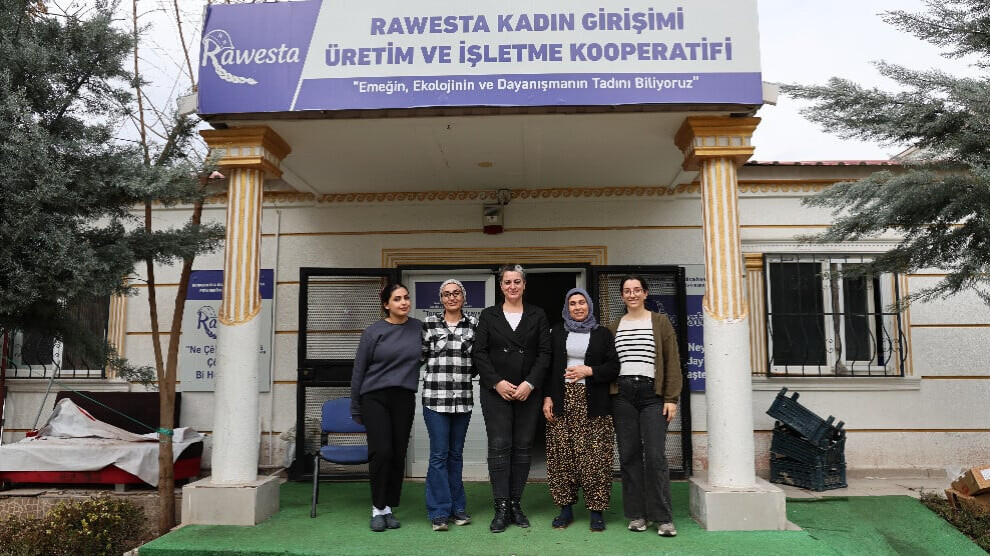
Rawesta Women’s Cooperative confronts women’s poverty and the hardships of prisoners’ families through collective production.
The Rawesta Women’s Cooperative, established under the leadership of the Association for Solidarity with Families of Prisoners and Convicts (TUHAY-DER), continues its work. The cooperative brings together women whose relatives are in prison, enabling them to take part in collective production, with the income generated used to support prisoners’ families and prison[er]s. Aiming to expand production in the coming period and reach more families of prisoners, the cooperative also seeks to extend support to detainees from Rojava and Eastern Kurdistan (Rojhilat) whose relatives are not present here. Working under the motto, “We know the taste of labor, ecology, and solidarity,” the cooperative aims to spread this initiative to cities across the region.
The idea emerged during family visits
The cooperative was established based on collective labor and solidarity in response to the economic deprivation experienced by women with relatives in prison. Yeter Erel Tuma, co-chair of the association, spoke about how the idea for the cooperative emerged and the process of production. Tuma said the idea of forming a cooperative took shape during family visits, explaining that women who struggled to care for their imprisoned relatives, were unable to attend prison visits, and were grappling with deep poverty came together out of the need to produce collectively. She described the initiative as “a project developed on the basis of collective labor and solidarity.”
We wanted to build a model based on a communal structure
Tuma said poverty is one of the fundamental problems in this country [Turkey] and pointed to the reality that women in Kurdistan are being systematically impoverished as part of a special war policy. Tuma said: “It has become inevitable to build a structure through which women can break out of this poverty by organizing themselves, by organizing one another and their labor. We could have established this structure as a company or another type of economic enterprise. However, we are aware that cooperativization is one of the most important tools for local development. We wanted to build a model that expands solidarity and is based on a communal structure.”
Women both work and expand support
Tuma said that collective meal production is currently carried out within the cooperative, noting that food is prepared for weddings, condolence gatherings, restaurants, public kitchens, trainings, and congresses. She added that the income generated covers all the cooperative’s expenses. Tuma said, “We place a particular emphasis on solidarity. All the women who contribute their labor within the cooperative have relatives in prison. These women are directly connected to the association and are relatives of prisoners who are members of the association. By organizing here, women aim to become economically stronger. This stems from the need to be able to support their relatives in prison and to attend prison visits.”
A solidarity commune is being formed
Tuma said the cooperative has another important goal, noting that the income generated is first used to cover all expenses and operational costs. She said, “While the women working here try to support their relatives in prison, they are also forming a solidarity commune for prisoners from Rojava and Eastern Kurdistan whose families are not present here.”
We want to expand solidarity through our own strength
Aslı Çelebi, a relative of a prisoner who works in the cooperative, said that being part of this initiative, where both women and families stand on their own feet, has given her great hope. Çelebi said that they produce, earn, and share without being indebted to anyone, and that they act in solidarity. She continued: “We established this cooperative with the spirit and idea of the commune. Here, we are doing everything we can to expand both production and our collective efforts. With the work carried out here, we want to reach more families of prisoners. We want to stand on our own feet without being indebted to anyone. Today, we cannot reach all prisons, and we cannot provide support everywhere. Through this cooperative, we want to support the prisons or prisoners we cannot yet reach, and we aim to do this through our own strength. We will gradually expand the areas of production. By standing side by side with families, we want to grow this place together. Together with the families of prisoners, we want to both produce here and expand solidarity. Now, seven women are working here, but through the production we carry out, we aim to reach all women.”