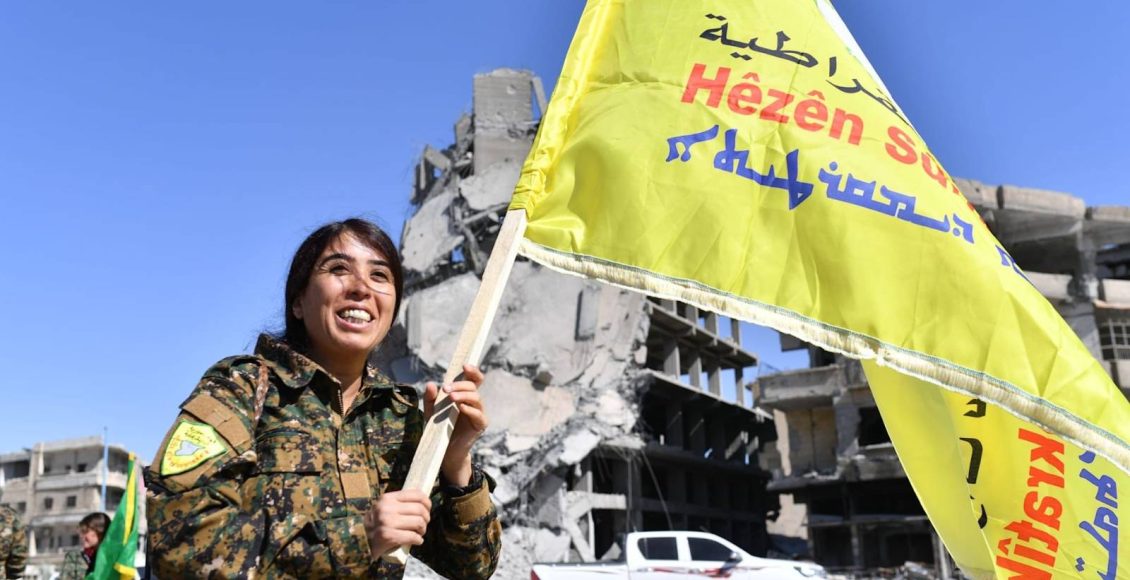
I still remember the first time I visited Raqqa. It was in June 2018. A few months earlier, in October 2017, the so-called Operation Wrath of Euphrates, which had entered its final phase in June of the same year, put an end to four years of Daesh darkness in the city it had proclaimed as the capital of its caliphate of terror. After months of fierce fighting, the Syrian Democratic Forces (SDF) led by the Women’s Defense Units (YPJ) liberated the city and its population.
Raqqa is a very ancient city, with an Arab majority where Kurds and Assyrians have always coexisted, with a desert climate but tinged by the intense blue of the Euphrates River and the green vegetation of its banks. When we visited in 2018, 90% of the city had been destroyed due to the war. I remembered very well the square from which the YPJ Command had announced the end of the Battle of Raqqa and its liberation. That square had been used by Daesh to spread its message of terror, placing decapitated heads around it, and people caged in its center. The same square that had been a symbol of the deepest brutality of our century for four years, now became a symbol of liberation and hope.
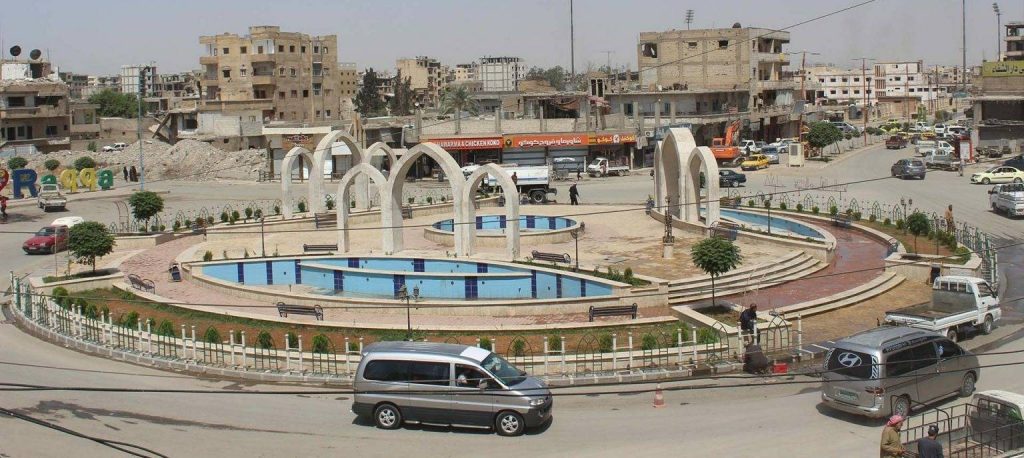
The second time I visited Raqqa was a few months ago. Seven years later, the city seemed different. From its ruins, Raqqa had risen again. The life, noise and color bore no resemblance to the silence, mistrust and sadness that permeated the first time. Raqqa had awakened from a nightmare that had been too long, and which was not easy to forget. With great effort and determination, the former Daesh capital had become the administrative capital of the Democratic Autonomous Administration of Northern and Eastern Syria, led by women, and with representation from all ethnic and religious communities. We had the opportunity to visit the Zenobia center, the women’s movement of the Arab regions, or liberated regions, as they called them. Arab women, like Kurdish women, were leading the transformation process of their society, carrying out awareness and sensitization work, and training and organizing other women. The center was adorned with small and numerous flags of Abdullah Öcalan, leader and founder of the democratic nation paradigm on which the Rojava Revolution is based; a paradigm within which the Arab women of Raqqa had found the possibility to exist. Images of Arab and Kurdish women who had been martyred by attacks from Turkey or jihadist groups could be seen in the room where they received us. Those women, who had lived under Daesh’s yoke and continued to rebel against the classic and traditional roles their community expected of them, were happy, strong and determined to continue insisting on freedom and dignity.
In recent days, with the attacks carried out by the groups of the Transitional Government of Damascus and Turkey in the region, and with Raqqa once again under HTS control, a new way of naming Daesh’s Salafist ideology, with all the images and information arriving from there about the return of the nightmare they were trying to forget since 2017, I constantly ask myself: What has become of them?
What is being attacked today, in addition to a people and a land, is a way and culture of life, dignity itself and the beauty of coexistence. But if Rojava and Raqqa have demonstrated anything in these years, it is that once women open their eyes, there is nothing that can close them again; once women have decided to live in freedom, they will always find a way to get there; there is nothing that can stop the strength and will of women.
I wanted to take advantage of this short article to share part of the interview conducted in 2019 with Cihan Sheik Ahmed, YPJ Commander and spokesperson of the Battle of Raqqa, published in the book Woman Life Freedom: In the Fire of the Women’s Revolution in Rojava. Cihan is a Kurd from Raqqa:
“For me it was a great experience to coordinate the war as spokesperson. I wrote my name in history representing the YPJ. I’m really happy. When the jihadists entered Raqqa I was there. It was like a wound. I was wounded in Raqqa. We had to leave. But in my head there was always the dream of returning to Raqqa, of liberating Raqqa. When the Raqqa front started it was natural that I participated. Because I know both the territory and the people. The people of Raqqa called us; they knew the Syrian Democratic Forces and the pain they suffered with Daesh had reached the highest level. Therefore, our start of the front was on one side for the people and on the other side revenge for the Yazidi women. Raqqa was a peaceful city. There are Kurds, Arabs, Assyrians… Our neighbors were from everywhere; Muslims, Christians. There were no differences among us. That city that is always beautiful in your imagination is now a place where women are sold, are raped. My family lived for a year in Raqqa under Daesh. The pain of the family and the people was the main reason to go liberate the city, along with the call of the people.
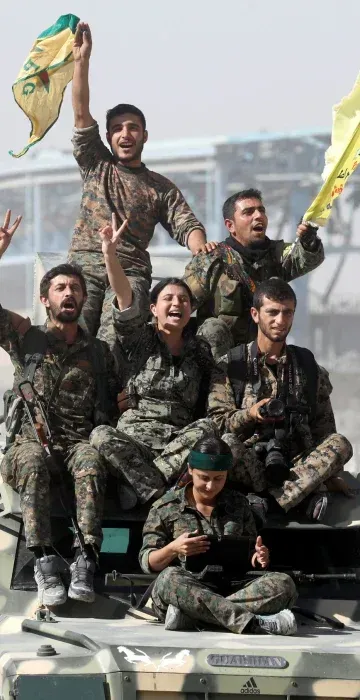
In Raqqa the reality was that there were women both in coordination, in combat and on the most advanced fronts. Our comrades also fought, I’m not saying they didn’t. But, to this day, all the wars in the world and in history were always carried out with the man’s mentality, and the war that men make is very different from the war that women make. The war that men make brings with it more destruction. It brings power. But the war that women make brings life with it. I was in Raqqa as spokesperson. Maybe at first they didn’t know us in the ideological sense, because we went directly to the front, but people saw in the women, in their struggle and in their sacrifice, the revolution of what we now call the revolution of northern and eastern Syria. We say that our revolution is for all of Syria, although previously the people of Manbij, Raqqa, Deir ez-Zor, were far from us. They didn’t like us much. On the front, women, men, girls or elderly women, when we moved them to security zones, saw our strength, that is, they saw life.
In the women of our Arab population, something very strange happened, because our Kurdish and Arab cultures are different from each other. In addition, we as Kurdish society have a heritage, we know the movement, and there is a sensitivity. Therefore, for years, we have always developed our search for freedom. This has always been in the Kurdish people. But in our Arab society, especially in women, it had not occurred. They learned about it after the liberation of these cities. At first, when young Arab women came to join us, they said, “give us weapons so we can take revenge on Daesh”. They had killed their father, or their mother, or their brother, they had cut their necks. They wanted revenge, because the pain that women have suffered with Daesh is really a very great pain. But after they arrived and joined us, the first need was for them to know themselves, to know their personality, to know their history and their existence, so they could make their decisions. That’s why we said, “our revenge is everything we can know about ourselves as women”. Our revenge is not just military. Why do I say this? YPJ doesn’t just go to war and fight against enemies. First of all, it aims to end this mentality of power that has been established in society for thousands of years; to break with the mentality of domination and build again women’s own will. When Arab women understood this reality they became stronger, in the sense of thought and confidence; it has been made known to the world that women, if they triumph mentally, are liberated. Until women are not mentally free, they cannot take up arms and fight. Daesh represents the highest level of the mentality of domination, a mentality that wants to eliminate us. If we are not united, if we do not carry out a strong struggle, if we do not make our organization bigger, we will always encounter this mentality. Daesh tomorrow will be called something else. It won’t be long before we finish with Daesh, but its mentality is still there. That’s why our struggle doesn’t end with the end of Daesh. Our struggle will end with the elimination of the dominant mentality. When we really build a free society with the color of women; then we can say that we have reached the result we want.
It was a very great triumph. On one side we fought, but on the other side we also made our organization bigger. We would take a town and all the youth would join us. They received training and participated on the front. Tribal leaders met with us, they helped us a lot, and the people were on our side. If in a war where the people are on your side, you will win; this is a reality. People said, “we are relaxed when we see that in front of a team there are women, we know that town will be liberated, that neighborhood will be liberated”. In Raqqa they said “Kurdish women”, but really they were YPJ women. For us it was a very great experience. The psychology of the people of Raqqa was different, because of Daesh’s violence. When you liberated these people, when you looked them in the eyes, you saw that the value of life, the hope for life, had died. For this reason, our Raqqa front was not only military but also social, it was a humanitarian front. How do you bring a person back to life? You listen to the children that Daesh has trained, and you know that these children have lost their childhood. War, murder, beheading, cutting off hands. When you hug them and they smile, something new is created inside them, you feel that they desire life. In Raqqa, when we arrived, people told us, “are you real?”. It was like a dream. Once, a woman approached me, kissed me and said, “this is enough for me, you are a woman who has come to liberate us”. A woman who comes to free women; a woman who comes to save women. Another woman said, “I look at you and I feel happy, I see myself in you”. True, we liberated Raqqa, we liberated Manbij, now (2019) we are liberating Deir ez-Zor, but these people have a great need for psychological help. Building a city again is not a problem, but building a person again, this is the most important thing. If we look at history, we see that all the wars that have occurred have been for power, for domination, but women fight for their existence, for freedom.”