Encounters with Women Between War and the Everyday Revolution
We dig deep, through the layers of millennia. We discuss the origin of life, we attempt to penetrate to a core that has survived the ages. We plant seeds in the ground that we nurture in cycles spanning many years, in the hope that people will one day live in the shade of these trees.
A button is pressed and within seconds a bomb explodes. In Syria, the ground is currently being buried on a massive scale. In Aleppo, entire neighborhoods were turned into landscapes of ruins within days. We work deeply and slowly; the enemy destroys superficially and quickly.
A few months ago, we were on a delegation trip to the self-administered regions of North and East Syria. Three weeks during which a whole world of experiences and encounters opened up. Today I read about the large-scale offensive by Islamist militias that, under the umbrella of the Syrian transitional government and with international backing, are heading toward Tabqa and Raqqa. Tabqa and Raqqa are two places that we also visited.
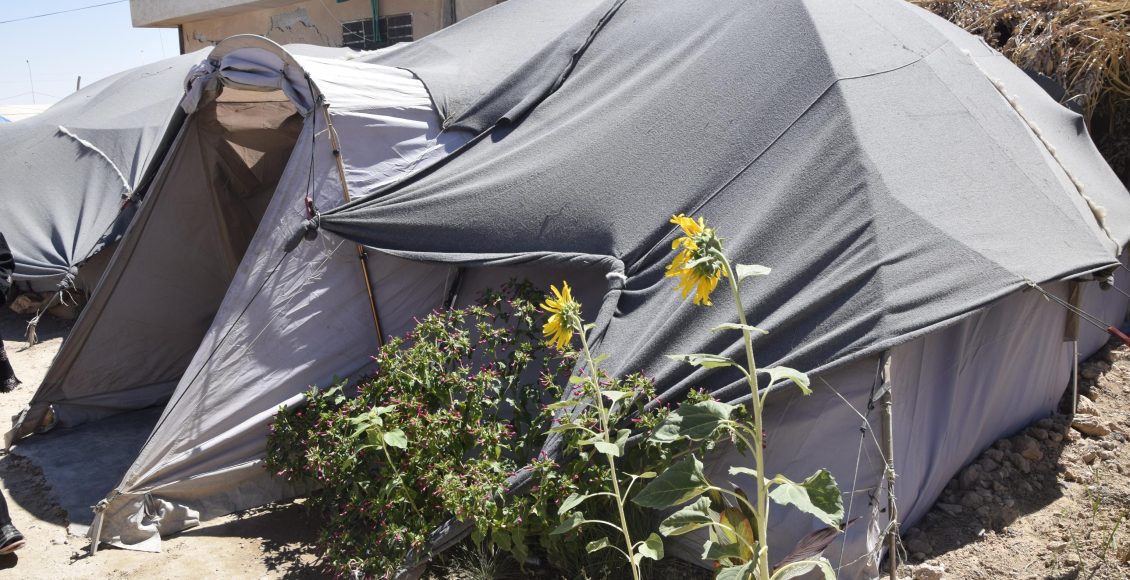
We spoke with women in the camp in Tabqa who had already been displaced twice. From Afrin, when the Turkish occupying state attacked their homeland, and then from Shehba, where they had remained in the hope of one day returning to Afrin from there. At the end of last year, they were displaced again from Shehba by the “gangs.” They call these groups “gangs,” by which they mean the SNA, HTS, Al-Nusra, and IS. The defense forces established a flight corridor for them. During their flight, they were insulted by the Islamists, saw severed heads, and received death threats. In the camp in Tabqa, we are invited by different families into their tents. The youngest here is three months old and the oldest woman has lived to see her 101st birthday. It shows me how strong this community must be for this elderly woman to have been able to flee. Between the tents, we meet a woman and a conversation develops between us about love and motherhood. She says: “This revolution is a revolution of love.” She says we must learn what love is and how we can open our hearts to all people. Like a mother who “loves unconditionally.” She says that this century will either become the century of women’s revolution or new fundamentalist-patriarchal values will take hold.
As I write these lines, I read that the “gangs” are standing before Tabqa. When I think of these people we met in Tabqa, I feel a deep knot building in my chest and a pain in my heart.
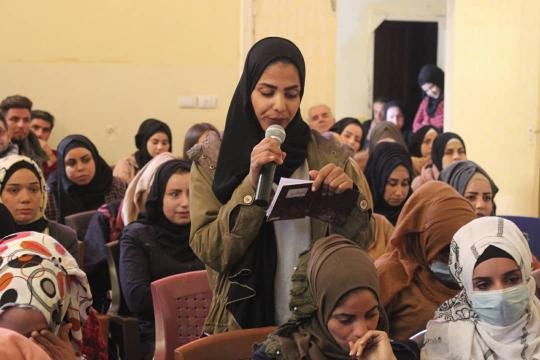
The women we met told us about the revolution that they have to fight for anew every day just to be allowed to be political at all. To be allowed to live independently from men at all. An Arab woman who is organized in Jineolojî in Tabqa told us that she was always looked down upon by everyone. Her family evaluated her work at Jineolojî as a waste of time. She was called lazy and good-for-nothing. Then Abdullah Öcalan wrote a letter from prison to the Jineolojî Academy. Suddenly the perspective changed. Her family realized that she was doing important work, if even Öcalan was addressing a letter to them. Since then, her husband always says when he sees her watching the news: ‘Oh, Jineolojî is watching the news.’ He knows that she is educating herself politically, that she is organized. That she has built up a political consciousness. This gives her power. This has triggered a small revolution in her, her family, and her marriage. Everyone knows that she is politically aware. That she is doing important work.
We talk about whether the philosophy of the Kurdish freedom movement contradicts the Quran. She shakes her head: “Religion has been instrumentalized.” A patriarchal understanding of honor allows men to murder, whether under Assad or under Islamist rule; they remained unpunished for it. One of the battles that women are fighting is to recognize these murders as such. The revolution has given them the political and legal framework to defend themselves against honor killings. But the work within families, with fathers, husbands, and brothers is a permanent revolution that women have been continuing for years. I will never forget the love and strength that lay in these conversations. While we spoke, as they patiently answered our questions, a child was passed from arm to arm around the table.
The movement changes people’s living situations. The women meet regularly, discuss and talk about the political situation. They speak with other women, organize them, give them hope. Hope for a different life. Hope for a liberated life. What will happen to them when IS militias stand at their door?
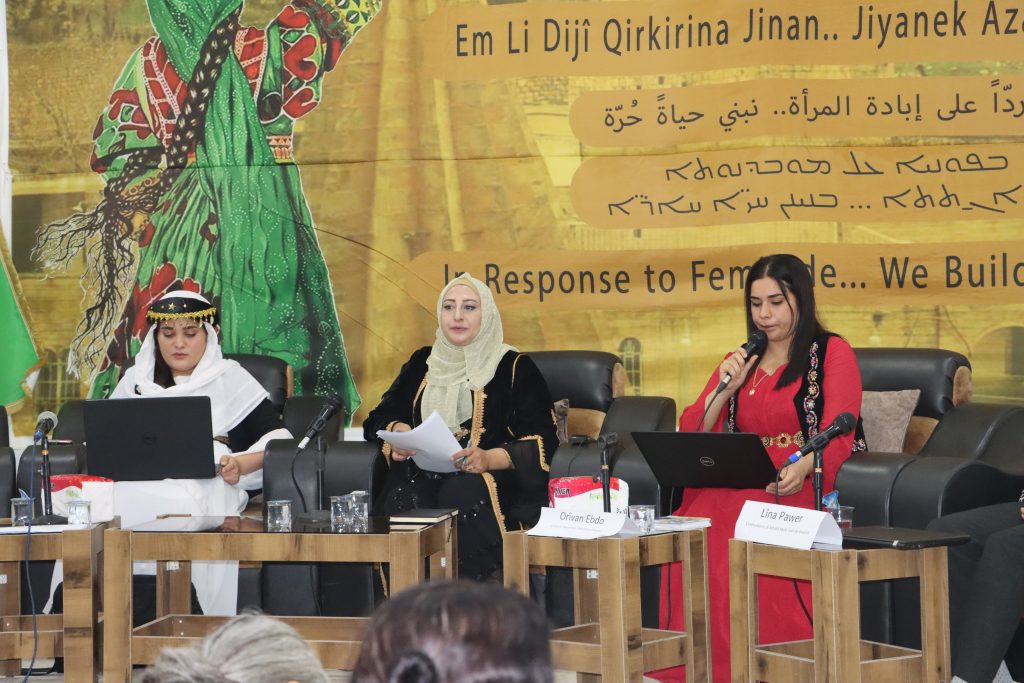
When we were in Raqqa, the women were more heavily veiled than in other areas of the self-administration. Our companion knew that the fear of IS is very great here. Raqqa was chosen by IS as the capital of the so-called caliphate. The fear of IS’s return makes it difficult to organize people. Hardly any woman goes outside here without a veil because they fear that if the Islamists seize power again, they will be murdered for it. It takes years before a woman can regain enough trust to raise her voice again. The IS gangs’ plan to take Raqqa aims to extinguish once more the sparks of hope that have been produced through painstaking work.
I think of Z., who lives in Tabqa. When we stood at her front door, she greeted us with a tearful face. We had arrived late; she had thought something had happened to us. We slept two nights in her apartment. Every day she brought us ice cream in the evening. She is a very self-confident woman. She ran away, left her husband behind, and joined the Kurdish freedom movement. “I am free now, it was the best decision I could make.” In Tabqa, we are accompanied by another woman. I immediately felt a strong connection to her. She was still young, mid to late twenties. Her hair was so long that it touched the backs of her knees. When driving, she often turned the music up very loud, singing along and looking at us with laughter. She always drove the car. To liberate Raqqa from IS, she fought in alliance with American soldiers. “The men always looked down on me. They thought they could do more, just because they are men. Not like with our forces. YPJ is much better.”
Once I woke up early in the morning and wanted to set the table ahead of time while the others were still sleeping. She was faster than me and was already standing next to the fully set table. She smiled at me and said: “So you can sleep longer.” We sat down together and tried to have a conversation through Google Translate. The background on her phone was the picture of a man. “Your boyfriend?” I asked. She said: “Yes, my husband. I had to get married. But life with my comerades was much better.” “Why don’t you go back and separate from your husband?” I ask. “It’s complicated. Family… We’ll see. You better stay with your comerades!” she says with a soft gaze.
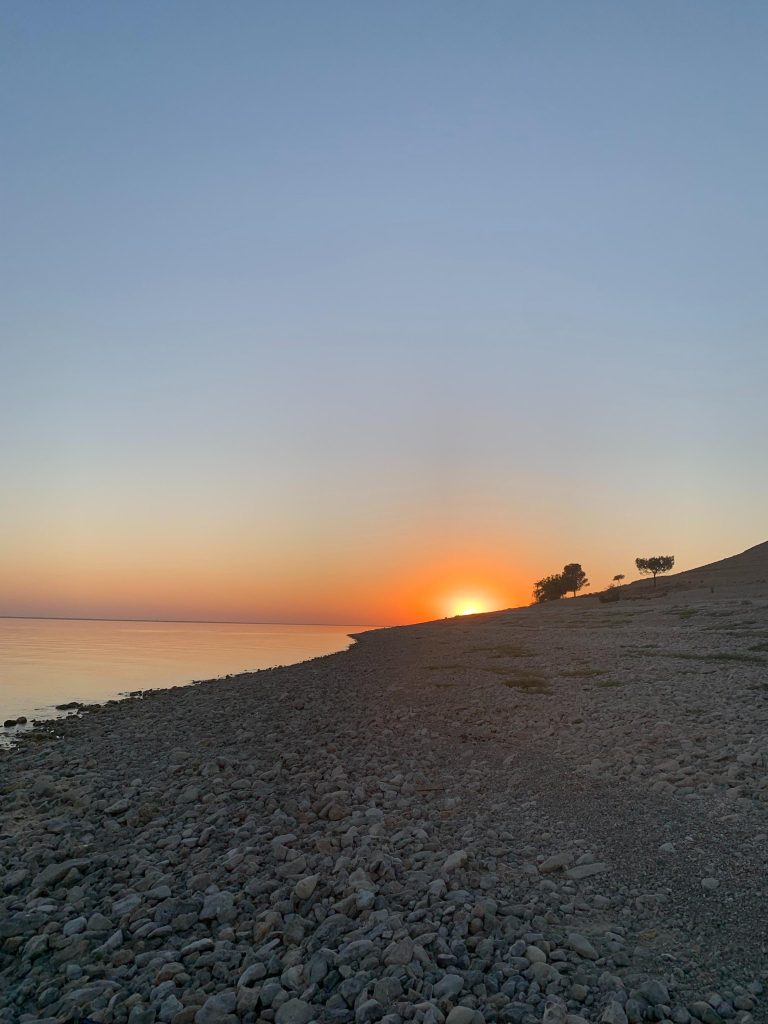
As we leave Raqqa and Tabqa, we go without being able to say goodbye to her. But S. tells us that she didn’t want to say goodbye because she is sure that we will see each other again. These are only small stories, but through them I carry Tabqa, Raqqa, the struggle and resistance of women in Syria in my heart. When I was there, every detail showed me what a great revolution the women there carry out anew every day by organizing themselves, building their own will, and defending themselves against attacks from all sides. The Kurdish freedom movement and the philosophy of Abdullah Öcalan have given them the strength that made all of this possible. A renewed invasion of Islamist forces into the region means for them displacement again, or imprisonment within the walls of the home, rape and murder.
My breath is shallow these days. The air doesn’t reach my belly. Constantly that short sound, my phone notifying me, again with new images, a new message about the attacks against the autonomous self-administration. So many years of struggle lie behind us—and so many ahead of us. We must be able to breathe. To breathe in all that has been achieved in struggles before us and that allows us to live.
I find a moment of clarity and calm when, between the messages on my phone, the image of a young woman appears. Şehîd Deniz Çiya was a commander of the resistance in Aleppo and a woman who fought to her last bullet for the defense of her people. Her last words were: “Those who cannot face death when necessary cannot become the breath of a free life.”
The river of this revolution is composed of millions of small drops, of encounters, conversations and moments, women who organize themselves in refugee camps, women who discuss freedom, women who save their last hand grenade to avoid falling into the hands of the enemy. Women who come together to build—and who choose hope in the face of destruction. Hundreds of revolutions every day, which in their totality will break even the hard stone of domination. In these days we are painfully reminded again: It will not be easy. But we will always continue to flow and never retreat.