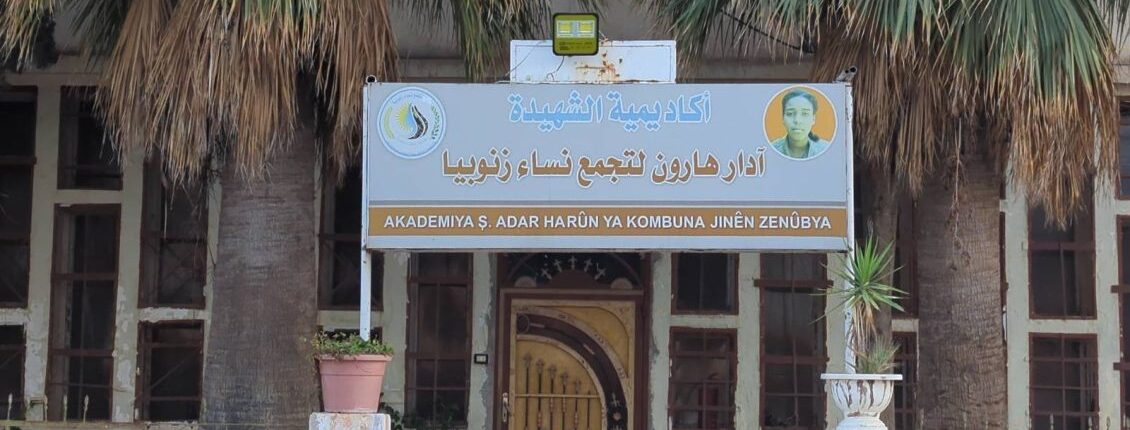
There are walls in hearts, walls between people coming together, walls blocking connection and development just like the border between the Turkish and Syrian Nation state, that is separating peoples and cities that used to be one. These days we see how walls can be overcome, with people on both side of the border chanting ‘the Kurdish people are one’. But we also see in these days, how a region, like Raqqa, that was once liberated, that was slowly recovering and flourishing, can be wrapped in black veils and flags again. How a place, that already once saw so much pain, can meet this violence again. With the attacks against Raqqa and Tabqa especially women who had been active in the institutions of the women’s revolution, who had been struggling for breaking barriers, are being threatened and forced to flee. As we wrote in our previous analysis on the situation of the war happening now, the centers of Zenobia, the women’s organization in the mostly Arab populated regions of North and East Syria, have been attacked and destroyed by the forces of the Syrian Transitional Government backed by the Turkish state.
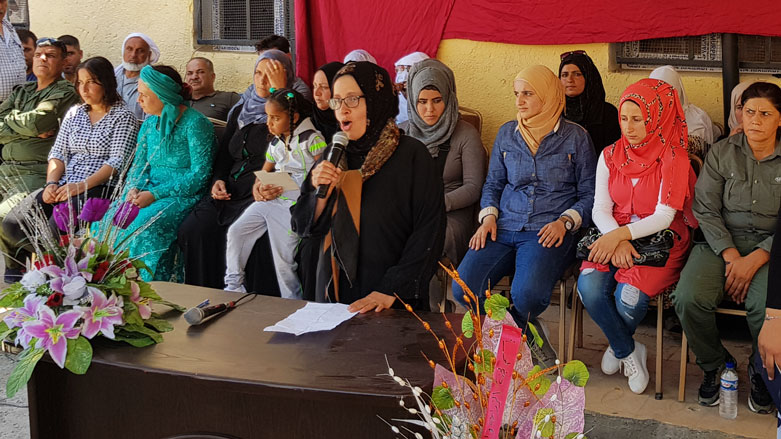
Some months ago we had the opportunity to meet and talk with the friends of the “Zenobia Women’s Gathering”. We talked about their struggles, how women become strong and the meaning of organizing as women in unity in women’s communes. We want the voices of the women of Zenobia to continually be part in our common struggle, especially as they are being silenced right now. We want their will and struggles to be known and heard, as there values and goals are being heavily attacked. We stand with the women, that are being murdered and attacked right now, and by making their words known, we want to articulate that our common struggle continues, as long as all women in the world are not stopped anymore from growing and can overcome the walls that condemns them from living their truth. Zenobia was founded in 2021 and named after the warrior queen of the Palmyra Empire, Zenobia. In Manbij, Tabqa, Deir ez-Zor and Raqqa women’s centers were built up and started their work to solve all social problems that are imprisoning women, such as domestic violence, underage marriage, polygamy, murder, divorce and inheritance. Arab, Circassian, Turkmen and Kurdish women organized together and built unity through their struggle against the mentality of male domination. The years of ISIS occupation left deep traces in the geography of this land, and in the mentality of society. Facing them as women means that the struggle for freedom includes many battles. In order to oppose the rules and traditions, the first step is to strengthen one’s will and to get to know oneself, which brings the taste freedom to women.
Interview taken on the 20th November 2025 in Raqqa. It is a translated version from Arabic into English.
What are you working for in Zenobia?
Noora: We are working here in Zenobia to improve [the situation of] women and to empower women in all the fields of life – in politics, economics – in every way. We are working to break the barriers inside, for every woman to know her truth and to make sure that she can be strong to take her gains. These days women are suffering from old traditions. From a lot of things. First of all, the violence, like sexual and physical. Also, women are forced to adopt thoughts that they don’t want, but that she must adopt these thoughts, because the men authority is forcing her to. Here, it is our job: to make every woman stronger, to be successful, stronger, so that she can have a better life than before. That’s it.
In what ways can women become stronger?
Noora: There are many ways. First of all, we visit women in their homes and give lectures to raise their consciousness about what they want and the rights they have. Every women needs to ask for her rights. You have the right to live. You have the right to learn. You have the right to do a lot of things. But in the right way. So we are making women conscious, so they know what they want for the future and so they can break the barriers inside their own hearts. You know, many women are afraid to ask for their rights because of the society. So, we are making them stronger. So, they can ask for their rights.
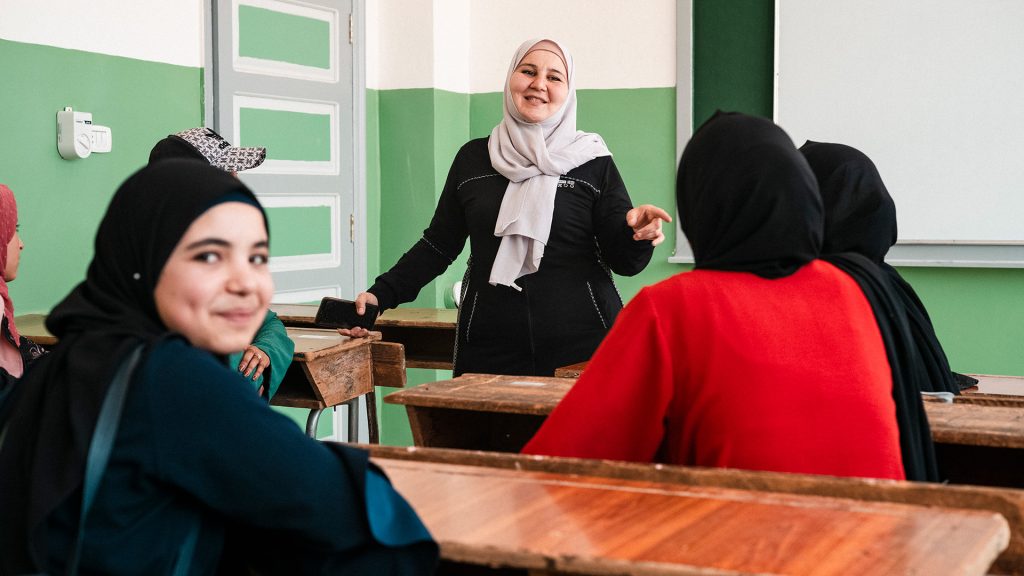
Leila: I want to add some more things we do to make women more conscious. First of all, the visits.We [also] have a project for giving lectures in Academies. We have Academies for women with a lot of programs. Some of them are closed. Closed means women come to the academy and stay there for one or two month, but without going home. And some of the programs are opened. That means that the program begins at 9.00 in the morning and goes until 3.00 in the afternoon. We do this because many women can’t [join the closed programs], because of their families and circumstances. Many families would never let their daughters go and sleep outside of their home. We want all women to be able to come to the Academy and take part in the lectures, to get to know themselves more, to be empowered and strengthened and to improve their social life and to improve their strength. All of this, from the academies and the lectures.
Can you tell about the changes in the women’s personality from the beginning to the end of the academies?
Noora: When coming to the Academy many women have a lot of difficulties. As we said before – the society, her brother, her father, men authority makes life hard for them. Women can not study, can not learn – but when they come to the academies, it is like entering a new world. She becomes stronger and it is like a shining on the women’s life, as she was living in darkness all of these years. In the academies, we support the women to get to know herself, her real self. That means they discover things in themselves they didn’t know they had, like abilities, preferences, hobbies. After the academy the women are more talented, more strong, more powerful and more confident in themselves. […] We keep supporting the women even after the academy. Because a lot of women are not confident in themselves, they cannot face the oppression on them. But when they are more strong [this changes]. And it’s a great thing that, these days, we find a lot of women going through the academies, they become teachers, they become leaders, like our friends here, we became leaders. [for the works of Zenobia.] So it’s like this for now, but we want to be able to make and give more. Not only for women here, but in all of Syria and all over the world.
How do the women come together and support each other in becoming stronger in your academies?
Noora: It’s about the spirit of friendship. All the women, when they come together as different personalities and from different environments, they become friends. They gain from each other with the touch between them. Even the teachers interact with each other as friends. As friends we do everything together and support each other in every way. It’s also possible to gain from each other’s personalities, like someone is very quiet and someone else very hard and often angry. By time, this angry person becomes more calm and the quiet person becomes more confident. They gain from each other. At the end of the academies the women cry when they separate from each other. They found each other in a group among friends, like families. They keep in touch with each other because they feel that they have a family, that they have support. They have someone that makes them more strong and more powerful. That’s it, the friendship spirit is the most important.
To continue this spirit of friendship: The system of self-governing in North-/East Syria is based on communes, as the smallest entities for society. When you hear the words “women’s commune”, what comes to your minds first?
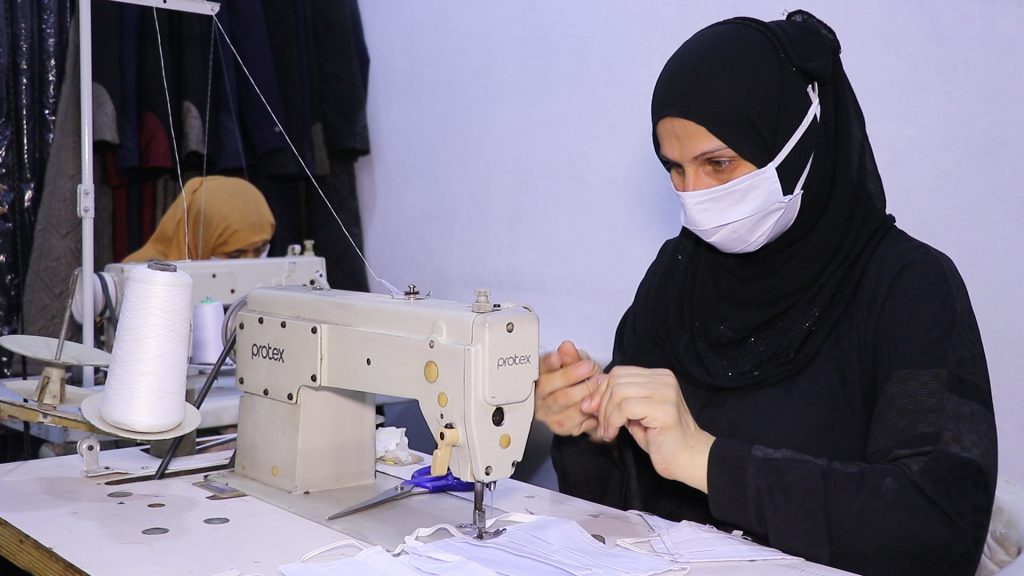
Asma: Our system of communes has two parts: a general one and an autonomous one, for women only. The communes connect all the councils and committees. As women, we are the only ones that can understand other women. That’s why [it is important] to have autonomous communes for women only. The job [of the women’s commune] becomes protecting women. That means to know every woman in the neighborhood and ask for her circumstances, to know if she is under violence or anything that is hurting her. And to let her know that she can give her voice to the commune and councils and be heard. We have autonomous self-defense committees and health communes. [These topics are also connected:] Self defense is to protect women’s health. We are working on this project these days. We hope in the future [this system of communes] will be more in all of our community. We hope that even in all of Syria, there will be communes for women, specifically for women, to improve women’s life all around Syria. Because women in Syria are under a lot of violence, a lot of exclusion from politics in every way. They are excluding women from politics, from working, from economics, from everything. Women do not take part and are suffering. We hope that we can reach all those women and support them by building communes. We hope by the beginning of the year, in 2026, to start a [phase of strengthening and empowering the communes]. It will need some time, but we are working on it. Communes for women are so important. […] A lot of women are living in villages. The job of the women’s commune is to also reach those women.
What are the biggest challenges with building up these women’s communes?
Leila: The biggest challenge is the traditional culture of this area and above this, after ISIS came – it’s mentality, which is spread among men. Men can’t accept that women form a commune or can become powerful. Or that women can do a man’s job – it’s not accepted for them. So it’s hard, we need to change men’s minds, to convince them that women can be in these positions of power. This is the biggest challenge and we can’t say it’s easy. But we can [change], always. Even after ISIS and all of this mentality – and it’s such a hard mentality – we can [change]. We are working hard for this. We hope that we can change. Also the women’s mind are touched by this. These thoughts of ISIS are so horrible, so we hope to change.
How do women overcome/address the mentality built up by ISIS?
Leila: It’s one of the biggest challenges. But as we said before, about the difference in women before and after an academy. When women are more powerful and more confident with their thoughts and themselves, they will not fear anything, even not the mentality of ISIS. Most of them [the women after the Zenobia academies] are now in positions of power, in institutes, on committees, positions of power, powerful positions and political positions. They start as a communal person, as women in the communes. And they can get women, they will get any woman, because they are not fearing anymore. Her thoughts change. This fear is always and was always inside the woman, not outside of her. You know, women are the enemy of themselves, because they don’t know what they want and don’t know their rights. Or if she got rights, or if she can do anything. She didn’t know all of this. She was like, living in the darkness for all of these years. [After the academies] she knows now that she’s powerful. She knows her rights, she know her gains, and she can protect even her gains. She got [this] from knowledge, from strength. She can protect herself and her gains. That’s what she does now. And then she tries to spread throughout all of the women to try to make more women like her. After becoming knowledgeable and strong, a woman begins to compare between her life and the mentality of ISIS. They will find the difference and reflect how she can actually live when there are rights. That brings woman to take a decision, to be strong and support more women to get rid of these thoughts and mentalities of ISIS that still live on. That’s why we as Zenobia even work with the women in ISIS camps to change women’s mentalities, to help them to get to know themselves and to compare their lives before and now. What the mentality of ISIS gives to women and how democratic thoughts give them their rights, their gains. In the mentality of ISIS, women don’t have a personality and are nothing for real. This mentality, becomes real when it is implemented. To change this is a difficult task. […] You can’t wait for someone to set you free. You must set yourself free.
What role are women playing in building up Raqqa today?
Leila: These days more and more women here in Raqqa work in a lot of positions. Women are building up Raqqa again – cleaning up Raqqa from what happened, after ISIS. One of our mayors, Leyla Mustefa, was the representative of the council of Raqqa. She was one of the nine mayors in the world – cleaning up Raqqa from what happened, after ISIS. You know the destroyed buildings and all of this. In every institute there is an office for women now, especially for women, to protect them within work. Women here are the biggest part that helps to build Raqqa, so it becomes more beautiful every day. These days, Raqqa became such a beautiful city. It wasn’t like this before because, you know, it was 90% destroyed. That’s the role of woman. Women worked a lot here. More than men. They worked a lot. That’s what they do here.
You talked about the women in the villages. How do you see the relationship between women and nature?
Leila: There’s something common between women and nature. Women were working on the fields, we’re daughters of nature. Women are making everything for themselves. You know, there were always more women working on the fields than men. So that’s why nature is so mixed with the women’s mentality. […] Women’s roots are between fields and trees. Every woman has roots like a tree, and they are strong roots. But we hope they become stronger and stronger with time. Women who live in the villages are stronger. That’s why you find a lot of differences between women in villages and women in cities, because of their relationship with nature. It makes them stronger. You see their bodies, their hair, their skin. Everything is different. Even their minds are. So they have strong personalities because of the nature and clean air. They don’t eat something like food in cans. Her mind is cleaner because of the nature, because of the clean air. In the cities we all are living a fast life, everything is fast. They are on the fields with the calves and everything – they do everything that men do, not like in the city. Here, the authority of men is stronger, you know, because they think women can’t be powerful. They think women are not strong. If they want a lawyer, they don’t want a woman as a lawyer. They want a man. She can’t defend me because she’s a woman… But, you know, a lot of successful lawyers were women.
Earlier you spoke about self-defense. What does this involve? I mean, I guess I would say I can’t defend myself just by myself, I need a commune. I myself am also on a big search, because I realized I’ve had very little self-defense throughout my life. This is one reason why I wanted to come to this revolution here in Syria.
Leila: For self-defense, first of all, women must know their rights. You as a woman, you should know your rights and break the barriers inside your heart. Do not be afraid. Don’t be afraid to know. Women are afraid to ask for their rights and this fear kills their voice. We need to set them free from the barriers inside of themselves. These are not walls within the society or like walls in a room. It’s inside the woman. So we need to help women to break the barriers inside of her heart, to know how to get out of there. Then, she must refuse to be under violence, to say no. Women think that they can’t say no. The first thing is, you can say no. Maybe it’s not easy always, but it’s easy when you know that you have to be strong and you know what you want. So first of all, you can say no. You can say no. Then we said, do not be afraid. In our academies there are lessons about self-defense. It’s necessary to learn both physically and mentally, because some of the violence is not by hands, but by words or thoughts. Forcing your own thoughts on someone is violence. Forcing a woman to stay at home, to not leave the house – it’s violence. Then there is also sexual violence. So as I said, at first you have to decide to say no, to not accept this anymore.
Earlier, you said that it’s, not just important to support women here, but in the whole of Syria and the whole world. Why is it important for you to support a woman on the other side of the world?
Asma: Well, because they are also women. We are women for each other. If she is in Darfur, in Africa, in Pakistan. You know, also in Pakistan, women are being sold. They are selling girls underage, to be a slave, to make a woman from her childhood as a slave. In Iran women are also suffering from Islamic thoughts. We are not looking from only our point-of-view in Rojava or Syria. We are looking for all woman in the world. Everywhere women are suffering, even in Europe. As a women’s gathering, we can be the biggest gathering in the world by joining all of the women in all of the world. And we are seeking that. Here, there are women in the military, as warriors. And, you know, women can be warriors all around the world. Women should not just be slaves for the authorities.
I also have a question regarding the women’s communality: How do you manage to bring women from different religions, ethnicity and cultures together?
Leila and Noora: You asked how the relationships are, how we gather all the women – Assyrian, Syriac, Arabic. They are all gathering because of the mentality. We, as women, all have the same goal. We are as women. We are not looking at you as, “you are Kurdish” or Arabic or whatever. […] Its the spirit of friendship, as I said before. We are working as a team, not as individuals, because we have the same goals, the same mentality. That’s what brings us together. It’s easy to understand each other, because we share a mentality. Also between us and you, we have the same goals, the same thoughts about women. We all want to struggle for women, that’s why. We don’t deal with it like, you know… We deal with you as a woman first and a human second. You are a woman and human. We don’t look for your race or your religion, or anything else. The point where we’re all together is that we are all women and want to struggle for women. You are from Britain, from Germany, and we come together as women for women.
Can the unity between women help to overcome separations in the whole of society like this?
Asma: That’s true, that’s true. We did not have a lot of separations before ISIS came and brought its mentality. I always drink my coffee in the morning with my neighbor. I don’t think about the fact that she’s Kurdish and I am Arabic. She comes to my home, I visit her, and we go out together. Before ISIS, kids were playing together, it was a normal life. ISIS raised these thoughts on people’s minds: “This is not Muslim. This is Muslim. This is Kurdish. This is Arabic.” Before ISIS there were not those thoughts. And now, with the Autonomous-Administration – we exclude all of these thoughts. We destroy all of these mentalities. We are all here, we are all humans, we have the same rights, we are all equal. You have rights as a human, first of all. Then as a woman, you have the right to be strong, the right to learn, the right to work, the right to say no and to say your opinion. They think that we are washing [women’s] hands, their minds somehow. It’s the opposite. They are washing their minds and making women think that her place is only in the kitchen. You can’t do all of this. That’s it. That’s a challenge for all the woman’s not only in Syria, but all over the world.