The Rojava Film Festival reveals how cinema in Rojava has grown into a revolutionary art shaped by memory, resistance and collective creation.
In Rojava, opening your eyes in the morning is never just waking up. It feels like searching for the traces that war and resistance have carved into the skin of this land, the breath left behind by sacrifice, the faint echo of a revolution that still moves through the air. I find myself looking for these marks almost without meaning to. That morning in Qamishlo, as soon as I pulled the curtains aside, the first thing that appeared before me was the quiet outline of religious buildings rising between walls worn down by war. Two church towers stood there, their crosses lifted into a pale and wounded sky. It is striking to see them in such a small town, a place that is not even a provincial centre, yet these two spires are the first shapes that claim the morning. I took a photograph and sent it to a Christian friend in Turkey. He found it just as moving and replied that one was Orthodox and the other Catholic.
In the early years of my youth, when our days were filled with socialist readings and revolutionary literature, we carried the assumption that socialists were meant to stand at a distance from religion. I still remember reading Sholokhov’s Harvest on the Don in high school. Almost every page described a world in which the spiritual life of peasants slowly faded as the Kolkhoz system expanded. We saw similar portrayals in stories from Cuba and Vietnam. Later, when we encountered critiques of real socialism, we realised something important had been missing. The famous line attributed to Marx, that religion is the opium of the people, had been torn from its full meaning. To correct our own misunderstanding, we had to return to what Marx actually wrote. There we found words that held much more compassion and depth. He wrote that religious suffering is both the expression of real suffering and a form of protest against it, that religion is the sigh of the oppressed creature, the heart of a heartless world and the soul of soulless conditions. Those words returned to me on that morning in Qamishlo as I stood before a landscape marked by war yet crowned by church towers. The image stirred something deep inside me and with that mix of sorrow and quiet recognition I stepped outside, carried by a feeling that the truth of the revolution was shining through everything around me.
Amûdê Cinema
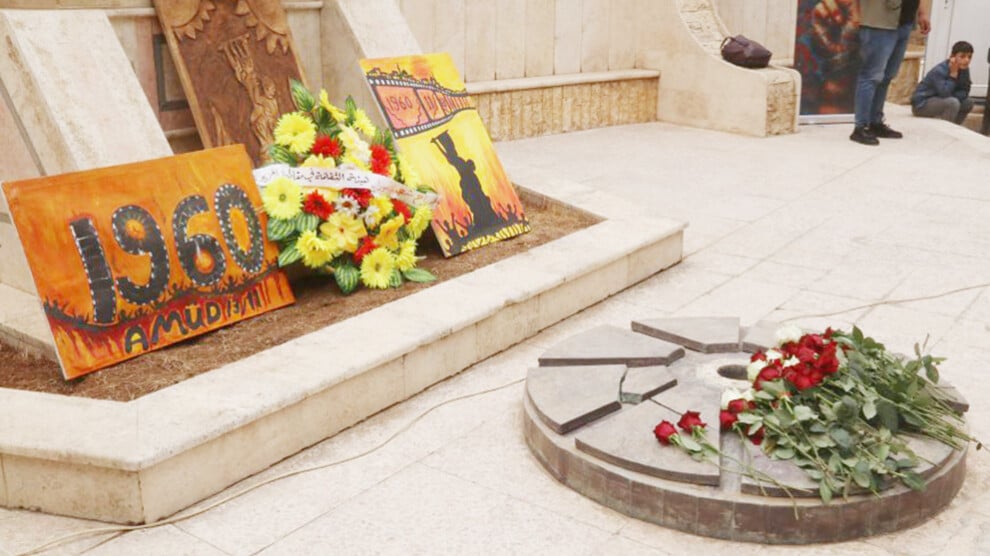
The first stop on the festival programme is the commemoration of the Amûdê cinema massacre, a destination that feels less like a visit and more like stepping into a wound that has never truly closed. We set off toward Amûdê in half-filled buses and a few private cars, carrying with us the quiet weight of what we are about to face. The massacre in Amûdê is not only a dark chapter in the history of Kurdistan or Rojava; it stands as a black mark on the history of humanity itself. Neither Caligula, nor Hitler, nor Timur, nor any architect of cruelty known to history, conceived of something like this. In 1960, nearly 500 children were herded into a cinema. The doors were locked. A fire was set. And in that sealed room, according to different accounts, 250 or 257 children were burned alive. Standing in Amûdê on 13 November for the commemoration is heartbreaking, even unbearable, for the opening day of a film festival. Yet without touching this wound, it is impossible to understand what cinema means to the people of Rojava, what it summons in their memories and their collective imagination. To describe the scene in all its rawness would require a heart stronger than mine. The surviving mothers, the siblings, the relatives of those children, still alive, still bearing the fire in their eyes, are not sights every human spirit can withstand.
After the commemoration, we visit the construction site of a new cinema rising in Amûdê, built in their memory. It will also be called “Amûdê Cinema,” a promise that their names will not be lost to time or silence. And it is not only here: across Rojava, in towns large and small, cultural centres and cinema halls are being built to bring art into the daily life of the people.
Shared stories and free cinema
The opening of the festival is unlike any other I have seen. I have attended many film festivals across the world, including in several African countries and mostly in Europe, yet it is rare to witness an opening filled with such energy. The young performers whose musicals I had admired in Mehmud Berazî’s work lit up the stage with rhythm and a beautiful sense of movement. Their presence alone was almost impossible to capture in words. And so the Fifth Rojava Film Festival began under the slogan “Çîrokên Hevpar, Sînemaya Azad”, meaning “shared stories and free cinema”.
The idea of shared stories is not based on something simple, such as sitting together and writing scripts. It carries a deeper meaning shaped by people who come from different parts of the world, who have seen Rojava, lived in it, joined the resistance and given their collective labour and their lives to reach the truth. It carries the desire to produce the aesthetic of this resistance and of life in this place, and to share this artistic celebration with both Rojava and the world. This is how I understand the essence of that phrase, because the foundation of the cinema revolution in this region is filled with concrete creative work that proves this idea directly. The concept of “Free Cinema” reflects this as well. The global state of cinema is widely known. It is almost impossible today for a project born from a free mind to be realised without a producer. Cinema requires a heavy financial investment, and even finding the money is not enough. Every film produced must now be made for the international market, and to enter that system the project must follow a journey that satisfies global norms and expectations starting from the script stage. First you must join script development platforms. Then comes project development, often called pitching, where you meet international producers and festival professionals whose approval or appreciation you must gain. Ideally, you find co producers through international platforms and only then can the film reach the shooting stage. Under these conditions, being part of the film industry means allowing your originality and your freedom to be tested and approved by global gatekeepers. For this reason, the idea of bringing shared stories together with free cinema in Rojava is also a stance. It is a line of refusal and a revolutionary manifesto against the global crisis of cinema itself.
81 films, 22 scripts
The festival brings together 81 films and 22 scripts from different countries. Eight of these films compete in the international category. Another eight appear in the national category, and seven are presented as Syrian films. The festival also features 21 documentaries, along with a wide range of seminars, panels and workshops on cinematography, film analysis and other areas of creative practice. Over the course of eight days, we watch films from many parts of the world, but it is the documentaries that resonate most deeply. A significant number of them turn their gaze directly toward the Rojava Revolution.
The struggle between the old and the new
What I have been able to observe through this festival is that the Rojava Revolution was never only the result of military action or armed resistance. It was not limited to cleansing those lands of ISIS groups, nor was it simply the removal of an imperial and colonial past from a geography whose people have lived there since ancient times and earned their right to exist as naturally as a mother gives milk. The Rojava Revolution was also the founding covenant of a shared life, a call for religions and beliefs and traditions to sit together. It was the moment when a political revolution took on flesh and form with the participation of people from across the world. It was a revolution of art as well, because Rojava had become a crossroads for free thought and independent creation.
At the same time, the Rojava Revolution became the living proof of the conditions needed for a revolutionary cinema. It stands as a real-world example of the distinction Jean Luc Godard drew between making political films and making films through political methods. For him, making films through political methods means grasping class struggle and realising it within film itself. It is, in essence, the struggle between the old and the new. In Rojava, almost everything I saw and observed reflected this. The cinema commune, the way work and life were organised, the importance given to cinema, the sincere and at times almost childlike excitement in the effort to create a new cinema, the understanding of cinema as a form of creation and as a material shaped by revolutionary transformation, all of this showed that a powerful current was beginning to pump blood into an entire body. And by body I mean Rojava, the Middle East and, if one looks closely, perhaps the world itself. Godard’s two principles help make this clearer. Making political films means understanding the laws of the objective world in order to understand life. Making films through political methods means understanding those laws in order to transform the world. What the cinema revolution in Rojava revealed to me, and to participants who came from many parts of the world, was exactly this. It was both the philosophical effort to understand cinema in its social meaning and the effort to transform, carried into life through the camera, the light, the sound, the script, the teaching spaces and the platforms of discussion.