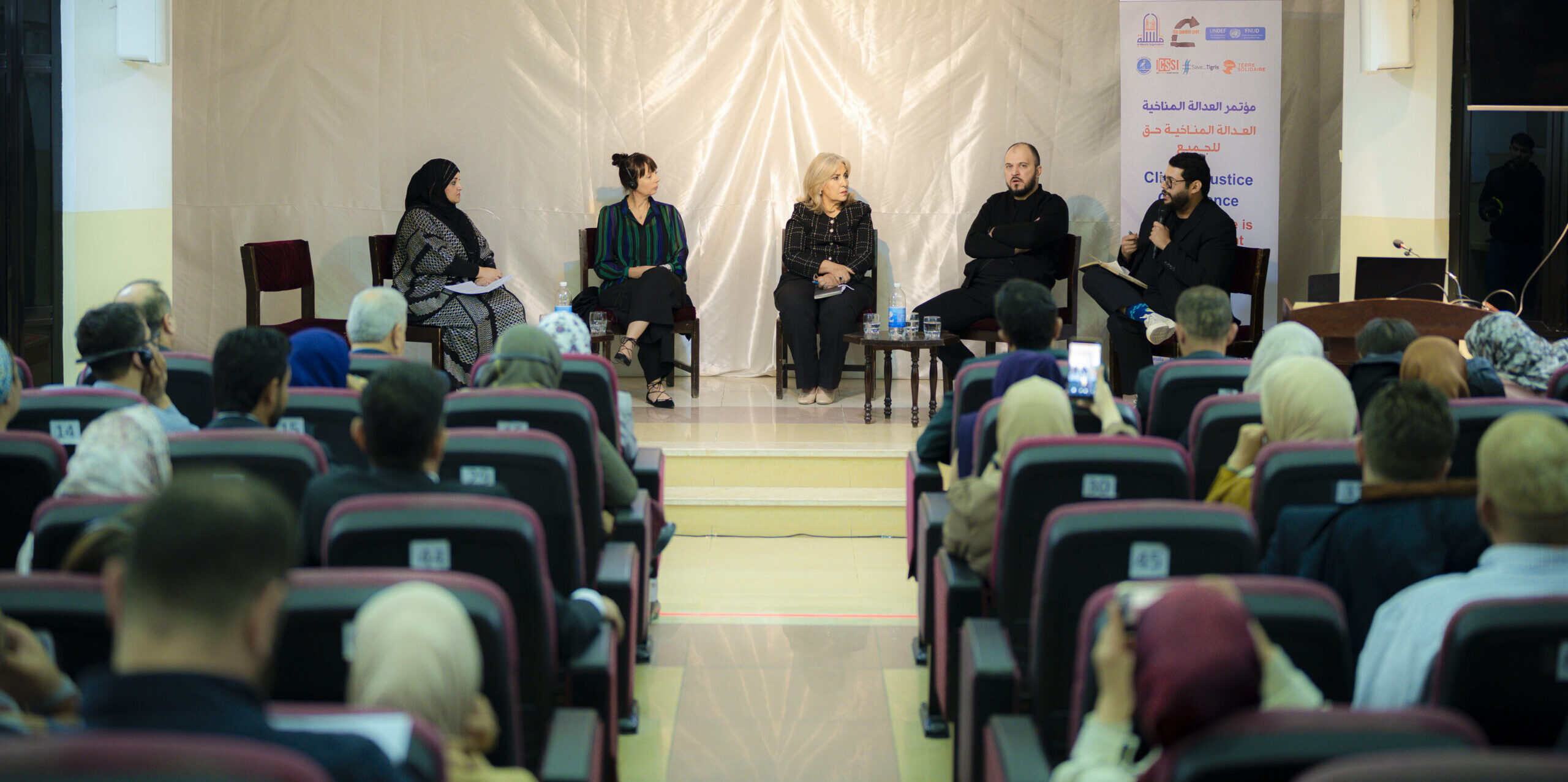
The first Climate Justice Conference took place in Baghdad, Iraq, bringing together civil society organizations, activists, and affected individuals from across Iraq and neighbouring countries. Organisers said the conference “serve[d] as a platform for building common perspectives, exchanging experiences, and raising the most pressing issues in the field of climate justice through a series of dialogue and interactive sessions”.
International and Iraq-based organisations collaborated to bring together around 100 participants in the capital city, in a joint venture between Iraq’s Humat Dijlah (Save The Tigris), the Iraqi Civil Society Solidarity Initiative (ICSSI), and the al-Masalla Organisation, in collaboration with Save the Tigris Foundation (Netherlands) and Un Ponte Per (UPP, Italy). The stated aim was to focus on “the voices of vulnerable communities and the reality of the direct impact of climate change on their civil, social, and environmental rights”, with organisers arguing that “the role of civil society is more important today than ever to ensure clear answers, serious demands, and just, actionable solutions for those affected by this crisis.”
Speakers included grassroots activists from regions particularly effected by the climate crisis in Iraq, including the gravely threatened marshlands in the country’s extreme south, the Nineveh region which has faced a severe and ongoing climate-driven drought since 2021, and the country’s semi-autonomous Kurdistan Region of Iraq (KRI).
Speakers also discussed related issues as they affect populations in neighbouring Iran and Syria, in all cases discussing the challenges posed by upstream control of the water supply, as well as the securitisation and politicisation of water resources in complex ongoing regional conflicts. This included a presentation covering the Water for Hasakeh campaign, which advocates for an end to the weaponisation of the water flow from the Alouk Water Station in North-East Syria, a crisis which has left hundreds of thousands of people in the region without access to their UN-recommended daily minimum supply of water. In addition to activists and grassroots NGOs, the conference also heard from experienced Iraqi journalists, academics and technical experts.
Alongside panel discussions, the conference saw break-out discussions focused on reflective assessments of how NGOs and activists can and should act to challenge climate injustice in Iraq and throughout the region. After the end of daily discussions, a cultural progamme offered a range of documentary screenings, art displays, and traditional music.
In a statement highlighting the importance of cross-border, cross-organisational discussions around climate justice, organisers said: “Although Iraq is considered one of the countries most affected by climate change, the causes of the crisis are not limited to environmental factors alone, but are also linked to domestic and regional policies related to water and natural resources. Hence, the conference affirms that climate justice is an integral part of human rights and social justice.”